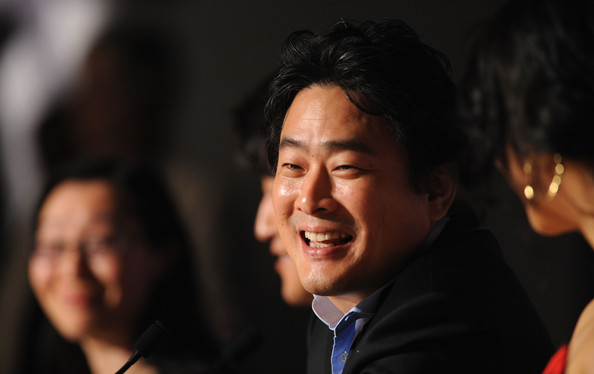
Everything turned black as all the credits finished scrolling, leaving me in a state which I don’t think I would be able to articulate in any of the language that I have mastered. It was not despair it was not ennui, neither distress nor emptiness. Perhaps delirium is the word that I can use without much of a frustration. That was the upshot of my first encounter with this phenomenon called Park Chan Wook. A young director hailing from the critically acclaimed wave of South Korean films which, for more than a decade, occupies a unique position in many of the prestigious film festivals conducted world wide. What makes Park unique or what all factors distinguish his film from the rest is a vexing question. Certainly it’s not the characters that amount to the difference, for there are no big chasms between his characters and that of Kim Ki Duk. Most of them are isolated, mentally disturbed and are pushed further toward the margins of sanity as the film progresses. Nor is the technical excellence in camera and editing. The blue tone that soothes the frames and the unusual and disturbing jump cuts that often disorient the spectator are familiar modus operandi for those who have themselves familiarized with this medium.
Then what else? What else compels us to sit patiently and live through the unsettling experiences of his films? It is the narrative style and strategy that does this magic. The immediate issue that smacks one’s mind after watching Park’s movie is the problem of genre- what kind of film is this, or to which genre does this film belong to? Film critic Betty Kaklamanidou in the essay Oldboy and the Suspense Thriller calls this anxiety as “genre trouble.” In park’s cinema we can perceive a conscious blending of genres that refute the usual classification of films on the basis of genre. Be it an Oldboy or Thirst we pick out certain calculated combination of genre in the narrative strategy of these films. In Thirst Sang- Hyun, a priest volunteers himself to a medical experiment project to separate a vaccine against a deadly virus. But the virus takes the priest, and a blood transfusion is urgently ordered up for him. Though he survives the experiment it turns him to a vampire. Despite being blood thirsty he restrains himself from taking the lives of the innocents and uses the blood of a comatose patient. Meanwhile he develops an affair with an orphan called Tae-ju who was married to one of his old friends. Sang-hyun soon plunges into a world of sensual pleasures, finding himself on intimate terms with the Seven Deadly Sins. With her bizarre love Tae-ju presses him for his blood and finally gets it from him. Shortly she turns out to be a blood thirsty vampire and kills people to alleviate her thirst. Having no other choice, he finally exterminates the two vampire bodies by forcefully exposing to light. This curtailed gist neither provides the real understanding of the film nor will it help one to follow the hard and fast rules of genre theories. It can be called a sci-fi, a vampire movie or even a love tragedy but no one would dare to use these terms to designate this film. Rather than making the spectator conscious of these exertions the narrative of the film takes us into its bizarre world. The surrealistic ambiguities alienate the world which is so familiar to us and at the same time reveals to us the dark and vicious psychosomatic realities. Park doesn’t build up a fantasy world nor does he indulge in fantasies just for the sake of it. Fantasies are the outcome of certain appalling repressions. Park’s protagonists in their effort to overcome these repressions indulge in excesses that finally trap them. In Thirst desires are vomited out in the form of sins that simultaneously liberate and trap the hero. Park’s characters are endowed with the freedom either to repress their desires or to indulge in them. In both case they are to take the responsibility of what follows. And in their attempt to take responsibility, Park says, his characters “are able to achieve some sort of integrity at the end of that.”

Another point that strikes us while going through Park’s movie is his excessive indulgence in violence – violence against the human body. Human body attains a different status in his films; it becomes a site of multitude of meanings in that it goes beyond the usual identification and objectification. Lee Geum Ja in the Lady Vengeance leaves Mr. Baek, who brutally murdered many kids to their parents to have their revenge. Despite the initial reluctance out of fear they finally torture and kill him brutally with scissors, knives and axe. They collect his blood in a large polythene mat which, like that in a military routine, is finally raised and folded as a flag after the blood is poured out through a puncture at the centre. Humanity is vaporized at the extreme temperature of vengeance. In Sympathy for Mr. Vengeance, Park Dong Jin slashes Ryu’s Achilles tendons opening a mouth above his heel through which blood gushes out to the river turning it into a pink stream. Park’s excessive use of knives and similar fatal weapons and his deliberate avoiding of guns reveal a kind of eccentric obsession for blood. Another protagonist Oh Dae Su in Oldboy cuts off his tongue with a pair of scissors rendering an ultimate cathartic effect to the film. Body becomes not just a metaphoric locale to dump the human vices and sufferance but it offers a stage to perform the turbulent social circumstances of the time. The employee in Sympathy for Mr. Vengeance wounds his body in front of Park Dong, his employer, reminding the fatal wounds capitalism has made on the body and psyche of the workers. The same employer in the end is killed by communist terrorists not for his capitalistic attitudes but for murdering an anarchist girl who had a role in his daughter’s kidnapping and her subsequent death. The final stab that pierces Dong’s heart through a notice from the terrorist reflects the pointlessness and perverted ideologies that tag along these usual revolutions. Perversions attain a totally different treatment in his films and often Park wraps them with the fabric of black humor. The boys living in the next room masturbates when Ryu’s sister yells with an abdominal pain due to a kidney failure mistaking it for orgasmic groans. This exciting style in which he employs black humor will persuade us to consider him as a North Korean version of Quentin Tarantino but the very source and outcome of this humor is essentially Park Chaan Wook’s.
Truly Park Chaan Wook is a new and vibrant cinematic experience that treads a totally different path to explore the human psyche. When asked about the philosophical thought that has find its way from his philosophy classes Park replied “If I was to comment on the specific trend in philosophy or a specific school of thought, perhaps I can say that I still have a trace of existentialism left from my studies. And also I have learned this attitude towards logic, or attitude towards the process of thinking, where I would have this subject, and I would create a sentence around the subject. And then keep following this chain of thought that derived from this subject until I’m met with a wall where I can’t go anywhere. Or, if I can put it another way, I have learned how to dig deep down and try and look for the root of where this subject originates from. I am not always successful in such attempts, but nevertheless, I try, and it’s this attitude.” Indeed it is this attitude of Park that gets reflected in his cinematic spaces that induces one to return to that space again and again.
